

Shipping a car from the United Arab Emirates to Nigeria has become a well-established and reliable process, supported by strong trade routes and consistent demand in the Nigerian automotive market. However, success depends on understanding the full shipping structure, import duties, and clearance requirements before the vehicle leaves the UAE.
At Milele, we regularly support buyers and exporters by sharing practical insights that help them plan shipments accurately and avoid unexpected costs. This guide outlines the process clearly, from export preparation in Dubai to customs clearance in Nigeria.
Step 1: Vehicle Purchase and Export Preparation (UAE)
Once a vehicle is purchased in the UAE, it must be prepared for export. This involves deregistering vehicles with local authorities, obtaining an export certificate, and ensuring the car is free from any financial liabilities. The vehicle should be clean and ready for inspection at the port.
Key export documents include original vehicle registration card, export certificate, commercial invoice, packing list, and passport copy or company trade license.
Milele Insight: Incomplete or inaccurate documentation at this stage is one of the most common causes of shipment delays.
Step 2: Shipping Methods from Dubai to Nigeria
Roll-On Roll-Off (RORO)
RORO is the most widely used shipping method for vehicles destined for Nigeria. The vehicle is driven onto the vessel and secured for transit.
Highlighted features are it is suitable for running vehicles, no cargo allowed inside the vehicle, and it is cost-effective for single-unit shipments
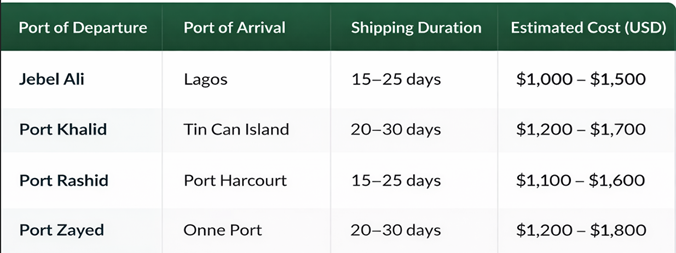
Estimated RORO shipping cost is USD 1,200 – 1,800
Container Shipping
Container shipping is typically used for multiple vehicles or when spare parts are shipped together.
For a 20ft container, the cost is USD 4,500 – 8,000, and for 40ft container, it is USD 6,000 – 12,000
Step 3: Ports and Transit Time
Vehicles are commonly shipped from Jebel Ali Port or Sharjah Port in the UAE.
In Nigeria, the primary receiving ports are Apapa Port and Tin Can Island Port in Lagos.
Average transit time ranges from 20 to 35 days, depending on vessel schedules and port congestion.
Step 4: Nigerian Import Duties and Taxes
Nigeria calculates import charges based on the CIF value (Cost, Insurance, and Freight) of the vehicle.
Typical charges include:
1. Import duty: 35% of CIF value
2. Import levy: 35% of CIF value
3. ECOWAS Trade Levy (ETL): 0.5% of CIF value
4. Value Added Tax (VAT): 7.5% applied on CIF plus duty and levy
In most cases, total import duties and taxes amount to approximately 75–80% of the CIF value, depending on the vehicle’s specifications and customs valuation.
Milele Insight: Customs valuation may differ from purchase price, making it essential to budget conservatively.
Step 5: Port and Clearing Charges in Nigeria
In addition to customs duties, buyers should account for port and clearing-related charges, including terminal handling fees, shipping line release charges, clearing agent fees, and potential storage costs if clearance is delayed.
These charges typically range between USD 300 and USD 800, depending on the port and agent involved.
Final Thoughts from Milele Insight
Shipping a car from the UAE to Nigeria is a straightforward process when managed with the right information and preparation. Understanding shipping options, import duties, and clearance costs in advance allows buyers to plan effectively and avoid delays.
At Milele, we believe informed decisions lead to smoother transactions. By sharing practical export insights and transparent cost structures, we help buyers navigate cross-border vehicle shipments with greater confidence and clarity.